


To measure a duffel bag, lay it flat, then measure the length, width, and height with a soft tape, and add the three numbers together to get its linear inches. To find the capacity in liters, multiply length, width, and height in centimeters and divide by 1,000. Many US airlines allow carry-on bags of about 22 x 14 x 9 inches, so a duffel under about 40 liters usually fits, but always check your airline.
Key Takeaways
- Measure length, width, and height, then add them for the linear total.
- Liters equal length times width times height in centimeters, divided by 1,000.
- Always measure the bag as you will carry it, packed and with its pockets.
- A common US carry-on limit is about 22 x 14 x 9 inches, but airlines differ.
- Soft leather duffels can compress slightly, but never count on it at the gate.
- Choose a size by trip length: 20 to 30 liters for short trips, 40 liters for a weekend.
How Do You Measure a Duffel Bag?
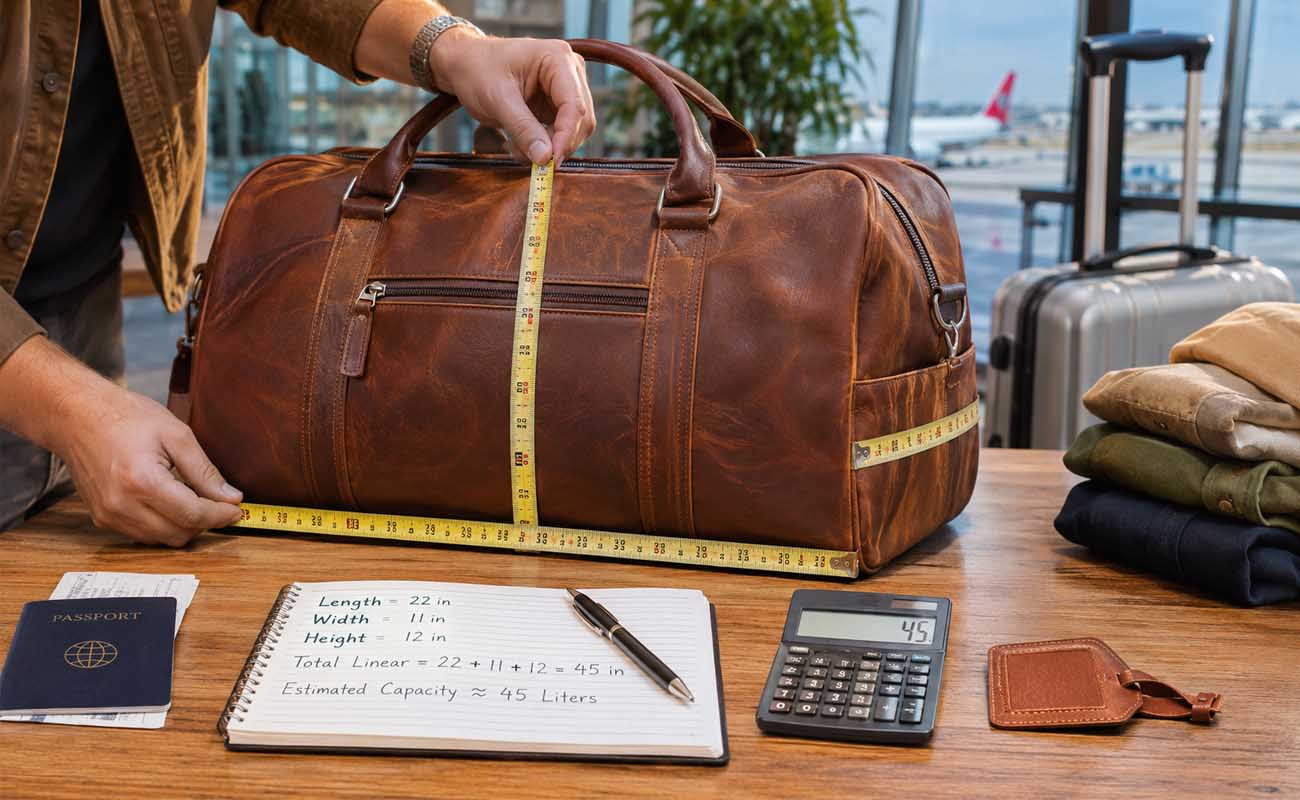
Measuring a duffel bag takes about two minutes and a tape measure, and it saves you from the most common travel problem, which is buying a bag that looks right online and does not fit your plans. The method is simple. You measure three sides, add them up for a quick compliance check, and convert them to liters if you want to compare capacity.
A duffel is a soft, rounded bag without the perfect edges of a suitcase, so technique matters more than the tool. Measure the bag in the shape it takes in use, so your numbers match what a gate agent or luggage sizer will see.
The seven steps below work for any duffel, from a small gym bag to a large travel holdall. If you are shopping, you can also use them to compare the product dimensions on a listing with the size you need. For flights, our article on whether a duffle bag fits under an airplane seat goes deeper into under-seat limits.
What Do You Need Before You Measure?
You need very little. A soft, flexible measuring tape is best, because it bends around the curve of the bag. A rigid ruler or a metal tape works as well, but it can push into the leather and distort the reading. You will also want a flat surface, such as a floor or a table, a pen and paper or a notes app, and a calculator for the last two steps.
Decide whether you are measuring an empty or a packed bag. An empty bag gives you the product dimensions, while a packed bag shows its travel size, because a full duffel is rounder and taller. If you can, take both.
What Are the 7 Steps to Measure a Duffel Bag?
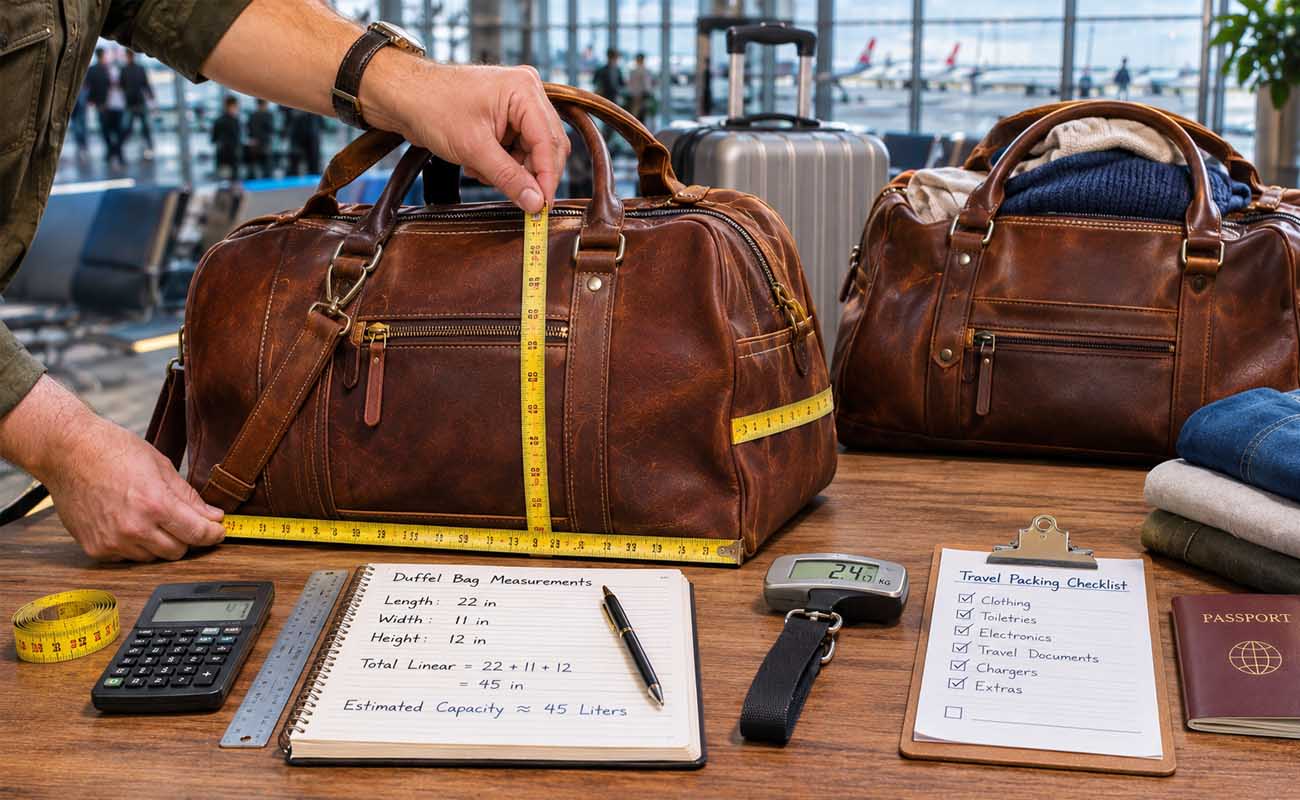
- lay the bag flat: place it on a flat, level surface, empty it unless you are measuring a packed bag, zip it closed, and let the handles lie flat. Do not press or stretch the bag.
- measure the length: run the tape along the longest side, from the outer seam at one end to the outer seam at the other, without pressing in. Exclude handles, but include large end pockets that stick out.
- measure the width: measure the shorter horizontal side, from the front surface to the back, at the widest point. Keep the front pocket zipped and flat, and include it in the reading.
- measure the height: stand the duffel upright and measure from the surface to the highest point of the body, usually the top seam. Do not include the handles, since they fold flat.
- add the linear inches: add length, width, and height together. A common US carry-on guideline is about 45 linear inches, which matches a 22 x 14 x 9 inch bag, but each airline sets its own limit.
- convert to liters: multiply each measurement in inches by 2.54 to get centimeters, multiply the three numbers together, and divide by 1,000. The result is an estimate of capacity in liters.
- Step 7, check weight and airline limits: look up your airline’s current size, weight, and personal item rules, and weigh the packed bag. For smaller bags, our guide on using a crossbody bag on flights explains how personal items work.
What Does a Worked Example Look Like?
Take a duffel that measures 21 x 12 x 10 inches. Its linear total is 43 inches, which is under the common 45-inch guideline. But its 10-inch height is an inch over the 9-inch limit, so a strict carrier could still refuse it, which is why you should check each dimension and not just the total.
To find the liters, convert the measurements to centimeters, which gives about 53.3 x 30.5 x 25.4. Multiplied together, that is roughly 41,295 cubic centimeters, or about 41 liters. This is a box-shaped estimate, so a rounded duffel’s real capacity can differ slightly because of curved ends, padding, and pockets. Use the number for comparison, not as an exact figure.
What Is the Duffel Bag Size Chart by Liters?
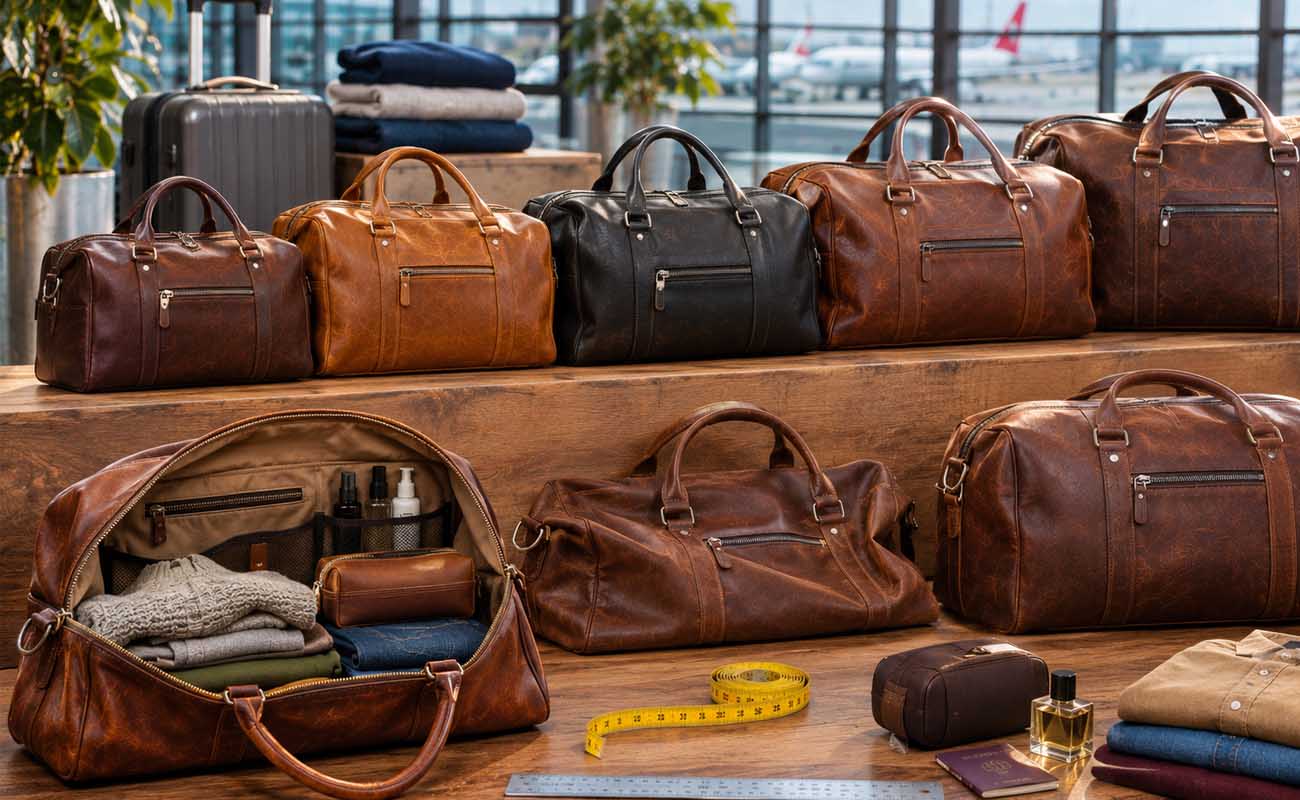
This quick chart links liters to dimensions and trip length. These are planning estimates, not industry standards, so use them as a guide.
| Capacity | Typical Size (inches) | Best For |
| 20 L | 17.7 x 11 x 6.3 | Day trip, gym, light overnight |
| 30 L | 19.7 x 11.8 x 7.9 | One to two nights |
| 40 L | 20.9 x 13 x 9.1 | Weekend trip, two to four nights |
| 50 L | 22 x 12.5 x 11.3 | About a week, bulkier gear |
| 60 L | 23.6 x 13.8 x 11.4 | Five to seven nights or heavy gear |
Should You Measure the Outside or the Inside of a Duffel Bag?
For travel rules, always measure the outside, because airlines and gate sizers check the full exterior, including pockets and padding. For packing, the inside matters more, because leather walls, lining, and padding take up room, so the usable space is smaller than the outside numbers suggest. A bag listed as 40 liters may hold a little less once you account for a thick lining and a structured base.
If you are comparing two bags online, compare the same kind of number, such as outside dimensions with outside dimensions. A listing that gives only liters does not tell you how the bag is shaped, so look for the length, width, and height as well, and check whether the numbers include pockets and handles.
How Do You Measure the Handles and Shoulder Strap?
Handles and straps do not count toward the size limit, but they matter for comfort. Measure the handle drop by holding the handle up and measuring from the top of the bag to the highest point of the handle, which tells you whether the bag clears your hand or sits against your leg. For the shoulder strap, measure its full adjustable range, from the shortest to the longest setting, and check that the longest setting fits across your body if you want to carry the bag hands free.
How Accurate Are the Measurements on a Product Listing?
Listed dimensions are a useful starting point, but they are rarely exact. Makers usually measure an empty bag laid flat, and they often round the numbers, so the finished bag can differ by half an inch or more. Leather also varies slightly from one hide to the next, and a handmade bag will never match a factory spec perfectly.
Treat the listing as a guide and confirm the size yourself when the bag arrives. Measure it using the steps above, write the numbers down, and compare them with your airline’s limit before your first trip. If the bag is meant for carry-on use and the size is critical, ask the seller for the packed dimensions or for a photo with a tape measure beside the bag, which shows the real size at a glance.
What Size Duffel Bag Do You Need?
The right size depends on the trip. A 20 to 30 liter duffel is enough for a gym session, a day trip, or a single night, and it fits easily under many seats. A 40 liter duffel suits a weekend, with room for a couple of outfits, shoes, and toiletries, though it sits right at the edge of many carry-on limits. A 50 to 60 liter duffel is best for a week or for bulky gear, and you should expect to check it on most flights.
If you travel mostly by plane, aim for a bag that sits comfortably inside the limit when packed, not just when empty. If you drive, size matters less, and a larger duffel can be a good choice for road trips. If you carry a laptop, make sure the bag has space for it or pair the duffel with a smaller bag.
Will a Duffel Bag Fit Under the Seat or in the Overhead Bin?
Space under an airplane seat is smaller than most people expect, and it varies by aircraft and row. A small to medium duffel of about 20 to 30 liters usually fits under the seat, while larger bags go in the overhead bin or get checked. Soft-sided duffels have an advantage here, because they can squeeze into a tight space where a hard suitcase cannot.
Do not rely on compression at the gate. A bag that looks like it fits but is rounded and overstuffed can get flagged by an agent with a sizer, and gate-checking costs money on many carriers. Measure the packed bag, leave a little room, and aim to be a small margin under the published limit.
How Does Leather Change the Way a Duffel Fits?
Leather behaves differently from nylon or canvas, and that affects both the measurement and the carry. Leather is firmer, so a well-made duffel keeps its shape and does not bulge as much when packed. It is also heavier, so the weight limit can matter before the size limit does. Thicker leather adds a small amount of bulk at the seams and edges. If you want to understand why, read our guide on how leather thickness is measured, which explains how heavier leather adds strength and weight.
Leather also softens with use. A new leather duffel is stiffer and holds its shape, and an older one relaxes and conforms to what you pack. That is a bonus for fitting into tight spaces over time, and it is a good reason to measure your bag again after a year of regular use.
How Do You Pack a Duffel Bag So It Keeps Its Size?
Packing well keeps the bag within its measured size and protects the leather.
- Roll your clothes: rolled items fill the corners and reduce bulging.
- Put heavy items at the base: shoes and toiletries lie flat and keep the bag stable.
- Use packing cubes: they keep the shape even and make fitting easier.
- Leave a little room: a slightly under-packed bag zips easily and stays within limits.
- Balance the weight: spread the load so one side does not sag.
- Zip pockets flat: a stuffed outer pocket can add inches to your measurement.
What Mistakes Should You Avoid When Measuring a Duffel Bag?
Small errors change the result enough to cause trouble at the airport.
- Pressing the tape into the leather: it understates the size.
- Measuring only the empty bag: a packed bag is taller and rounder.
- Ignoring pockets: outer pockets count at an airline sizer.
- Including the handles: handles fold flat and should not add height.
- Skipping the weight check: a bag can fit and still be overweight.
- Trusting the listing alone: measure the bag you own.
Why Buy a Leather Duffel Bag From Unique Leather Bags?
Unique Leather Bags (ULB) makes leather duffel bags built for travel, with quality leather, reinforced stitching, and sturdy hardware, so they hold their shape trip after trip. Browse our full range of leather duffel bags and duffel bags, or look at the Nomad’s carry-on, the Weekender’s Voyageur, the Vantage Overnight, and the Convertible Holdall.
You also buy with confidence. ULB backs its products with a 5-year repair and exchange warranty, a 30-day return policy, and free shipping on orders over $150. For more travel and care advice, browse our leather bag guides.
Frequently Asked Questions
Lay the bag flat, then measure its length, width, and height with a soft tape measure, without pressing into the leather. Add the three numbers for the linear inches, and convert to liters if you want to compare capacity.
Convert length, width, and height to centimeters, multiply them together, and divide by 1,000. A bag of 21 x 12 x 10 inches is about 41 liters.
A common US carry-on limit is about 22 x 14 x 9 inches, or about 45 linear inches, but airlines differ. Check your airline’s current rules, and measure the packed bag.
A 40 liter duffel suits most weekend trips of two to four nights. It sits close to carry-on limits, so measure it packed.
Usually they do not, because they fold flat. Outer pockets do count, because airline sizers measure the whole bag.
Yes, if it fits the airline’s size and weight limits. Leather is heavier than nylon, so check the weight as well as the size.
Final Thoughts
Measuring a duffel bag is quick: lay it flat, measure the length, width, and height, add them up, and convert to liters. Measure the bag as you will carry it, check the weight, and compare the numbers with your airline’s current limits. Choose the size by trip length, leave a little room, and your duffel will fit your plans and the airport.
When you are ready to choose one, browse our leather duffel bags or look at the Authentic Pioneer leather travel duffel bag and the Transit hand luggage for a travel-ready option.


