


To tell if leather is real, check the grain for natural irregularity, press it to see if it wrinkles like skin, look at the edge for rough fibers, smell it for an earthy scent, and put a drop of water on it to see if it soaks in. No single test is perfect, so combine three or four. Real leather looks uneven, feels warm, and smells natural, while fake leather looks uniform, feels cool, and smells like plastic.
Key Takeaways
- No single test proves leather is real, so use at least three together.
- Real leather has an irregular grain, while fake leather repeats a stamped pattern.
- A fibrous, layered edge points to real leather, and a plastic or fabric edge points to fake.
- The water drop test is useful, but finished leather can also repel water.
- “Genuine leather” is a low grade, not a promise of high quality.
- Never burn a finished product to test it. Use only a scrap, if at all.
What Does “Genuine Leather” Actually Mean?
The word “genuine” causes a lot of confusion. In the leather trade, genuine leather is a grade, and it sits near the bottom of the usable range. It is real leather, made from the lower layers of the hide after the strongest top layer has been removed, and it is usually coated with a printed finish to look better.
The grades above it are top-grain and full-grain leather. Top-grain keeps the upper layer but is lightly sanded, while full-grain keeps the entire natural surface and is the strongest and longest-lasting. Below genuine leather comes bonded leather, which is ground leather scraps glued together with a plastic coating, and then fully synthetic materials such as PU and vinyl.
So when you ask whether a bag is “genuine leather,” you are really asking two questions. First, is it leather at all? Second, which grade is it? The tests below answer the first question, and the label and the build answer the second. If you want to see how one of the confusing middle categories compares, read our guide on bi-cast vs genuine leather.
Which Test Should You Start With?
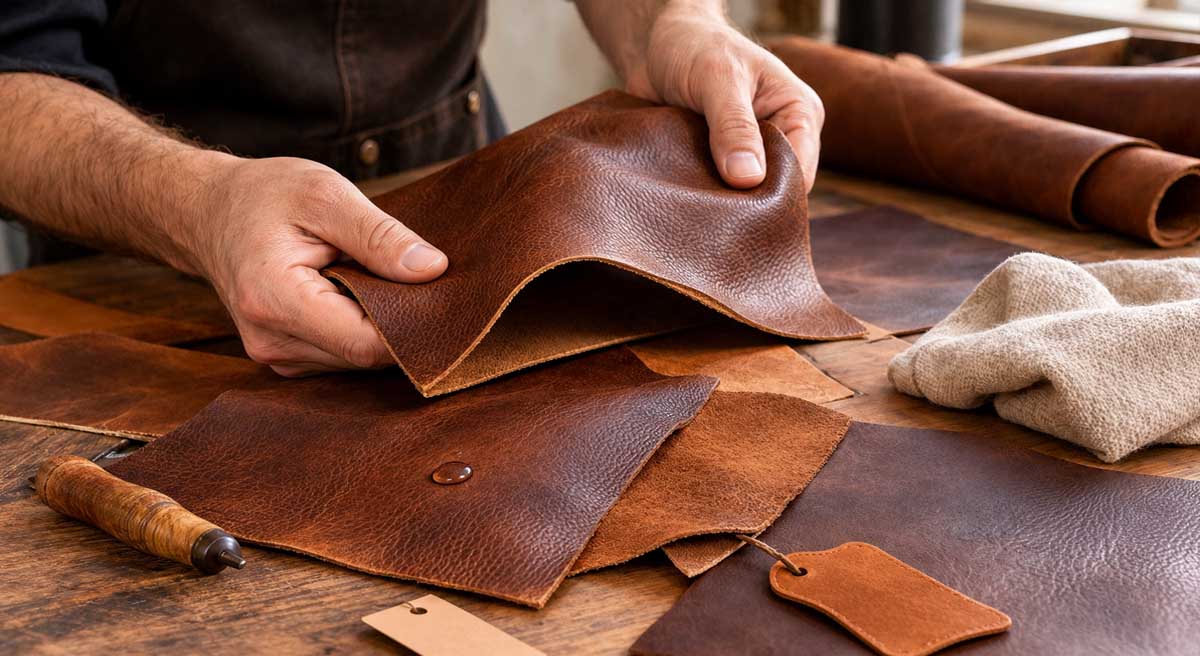
Start with the tests that cost you nothing and risk nothing. Here is how the eight tests compare.
| Test | Effort | Risk to the Item | How Reliable Alone |
| 1. Grain check | Low | None | Medium |
| 2. Touch and temperature | Low | None | Low |
| 3. Press and wrinkle | Low | None | Medium |
| 4. Smell | Low | None | Medium |
| 5. Edge and underside | Low | None | High |
| 6. Water drop | Medium | Low | Medium |
| 7. Label and price | Low | None | Medium |
| 8. Scratch and rub | Medium | Low | Medium |
A sensible routine is to begin with tests 1, 5, and 4, which take under a minute and need no tools. If the results disagree, move on to the press test and the water drop. If you are buying online, tests 7 and 5 help most, because you can check the label and any photos of the edge before you order.
Test 1: Does the Grain Look Natural?
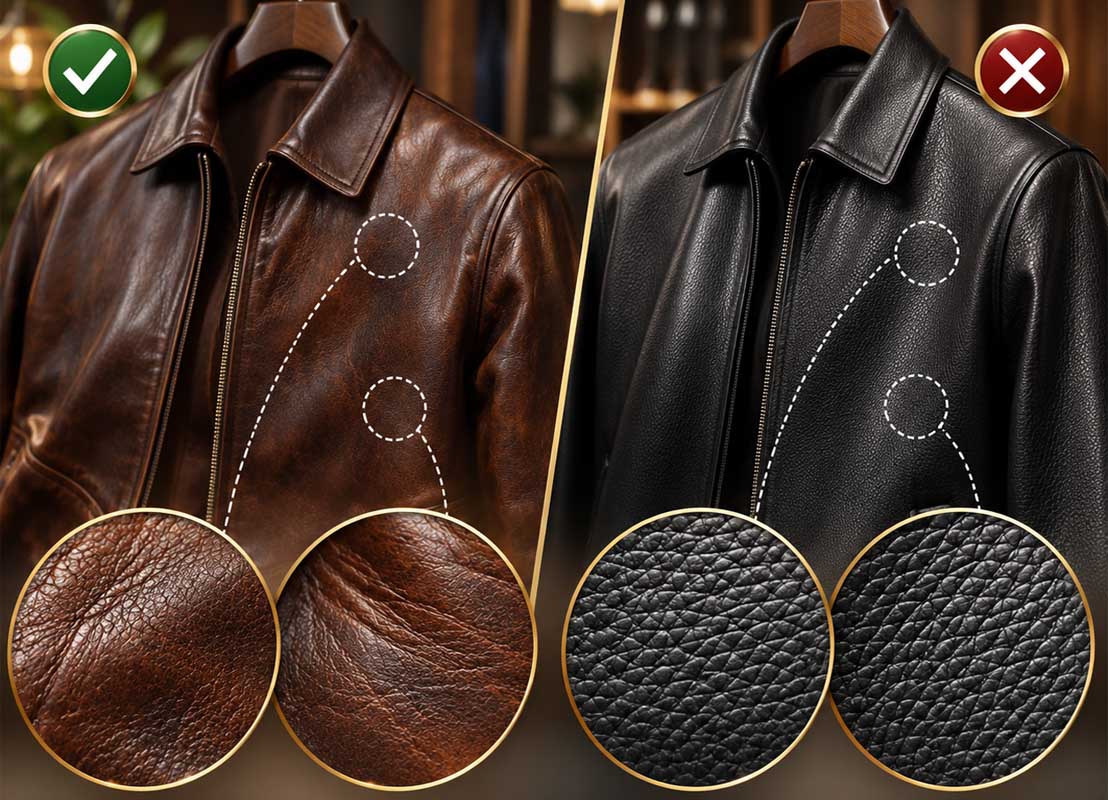
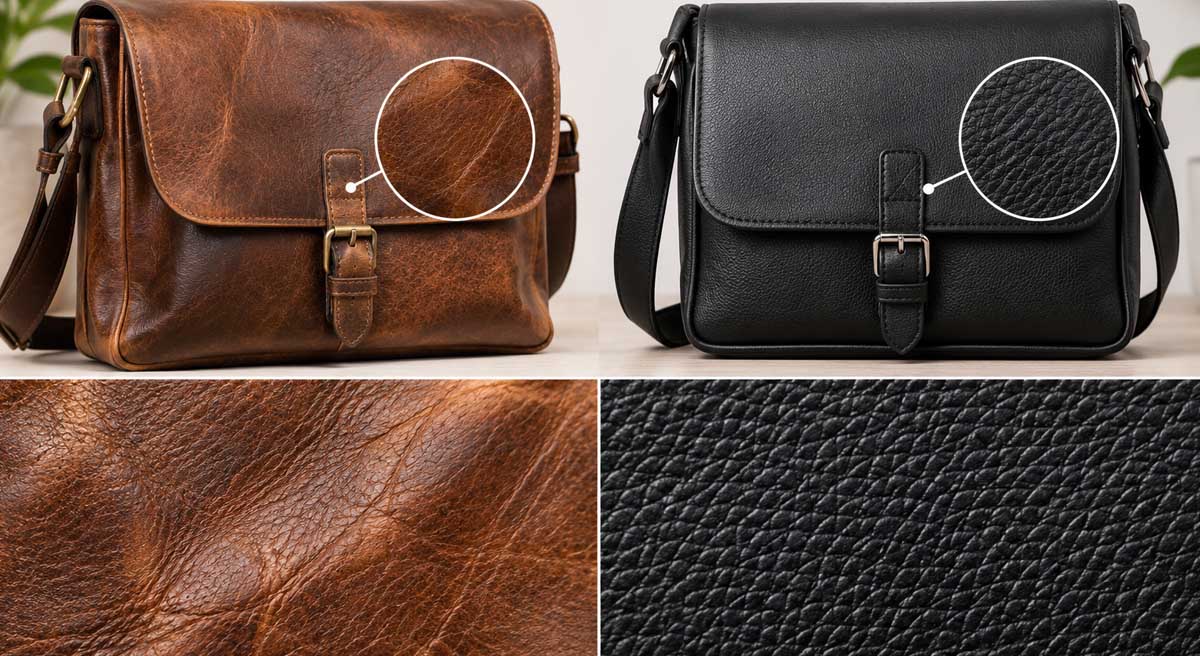
Look closely at the surface under good light. Real leather has a grain made by the animal’s skin, which means tiny pores, small wrinkles, and slight color changes from one spot to the next. Two bags made from the same hide will never look identical, and that variation is a good sign, not a flaw.
Fake leather is made in a factory, so the pattern repeats. If you see the same bumps in the same arrangement every inch or two, the surface was stamped. Zoom in with a phone camera and compare two spots several inches apart. Natural leather looks different in each, while embossed fake leather looks copied.
One caution applies here. Genuine leather and corrected-grain leather are often embossed with an artificial grain too, so a uniform pattern proves the surface was altered, not that the product is plastic. Treat a repeating pattern as a hint to check the other tests more carefully.
Test 2: How Does It Feel in Your Hand?
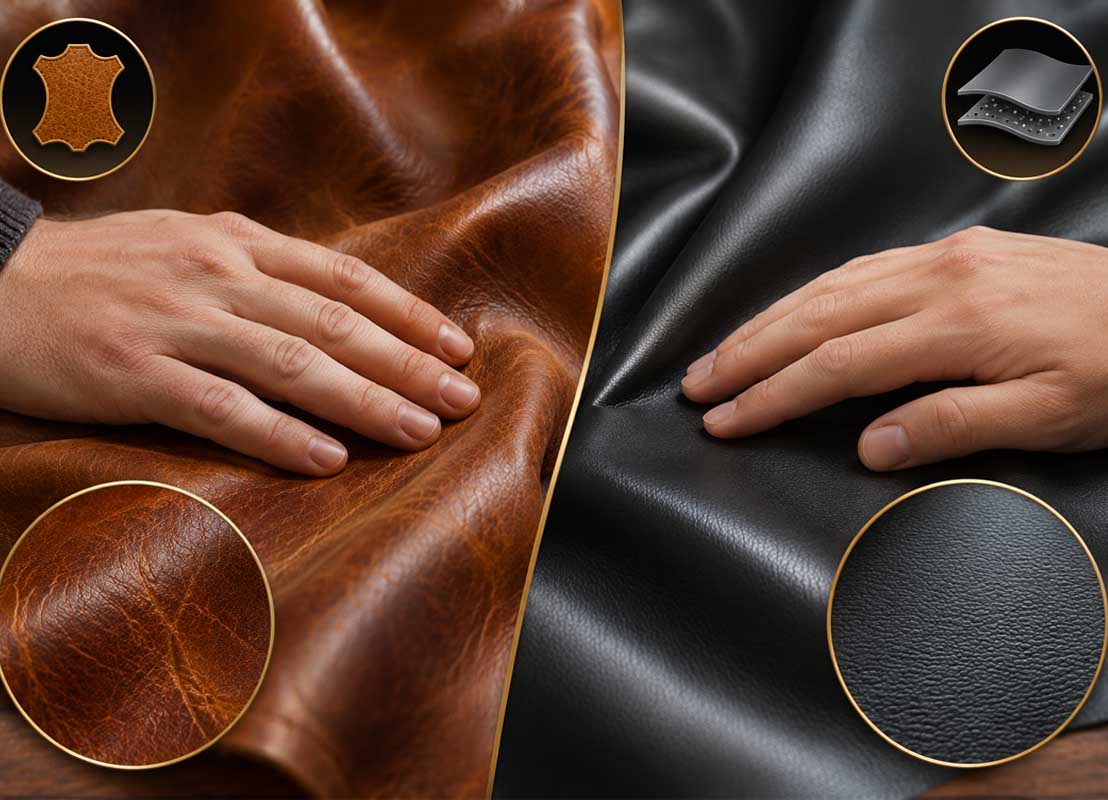
Run your palm and fingertips across the surface. Real leather feels slightly warm after a few seconds, because it is a natural material that takes on the heat of your hand. It also feels slightly varied, with a soft, supple feel that is not perfectly smooth. Fake leather often feels cooler and more uniform, and some versions have a rubbery or plasticky surface.
This test is subjective, which makes it the weakest of the eight, so use it as supporting evidence. Heavily coated leather can feel smooth and cool, and a good synthetic can feel soft. Real leather is also generally denser than a synthetic item of the same size, which helps when you compare two similar products.
Test 3: What Happens When You Press It?
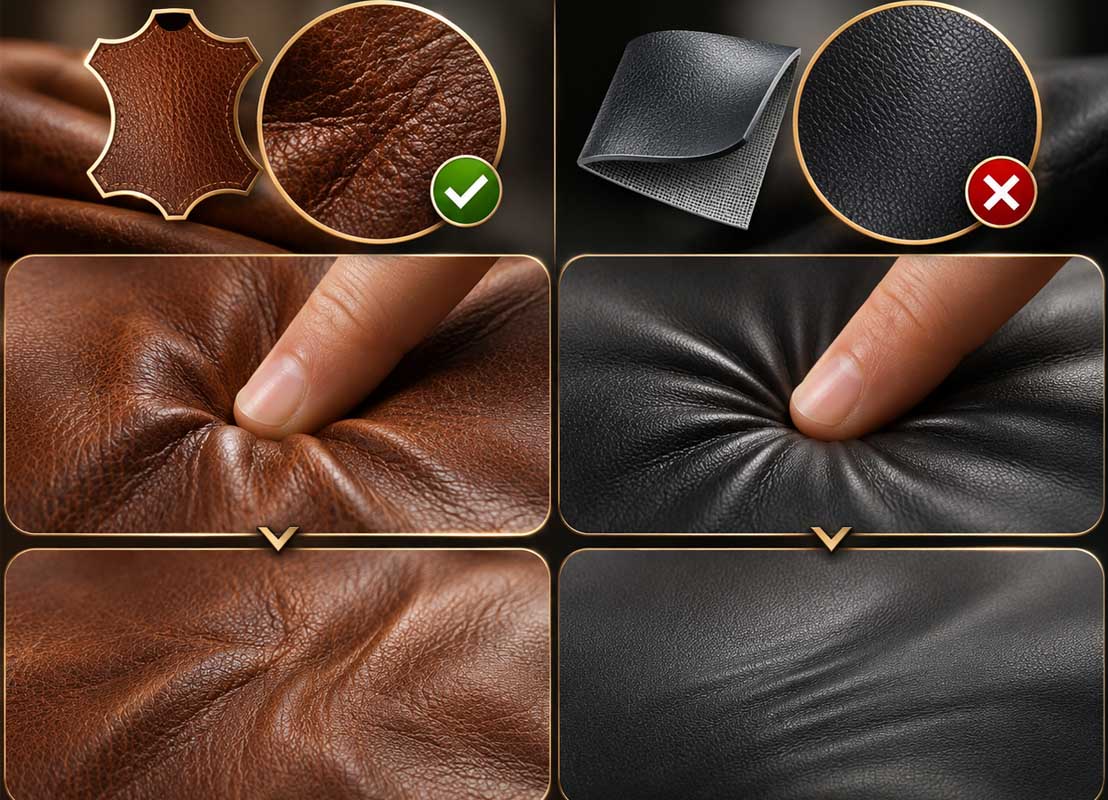
Press your finger into the surface and watch what happens. Real leather wrinkles naturally, like skin, and the wrinkles form unevenly and shift as you press in different places. When you let go, the surface recovers, often with fine lines that fade after a moment.
Fake leather behaves differently. It tends to stretch smoothly without wrinkling, or it forms tight, even creases that look like fabric. Over time, synthetic coatings can also crack along stress points. If you flex a corner of the bag, real leather bends with changing patterns, while fake leather creases in repeating lines. Be gentle, because bending a product hard can damage it.
Test 4: What Does It Smell Like?
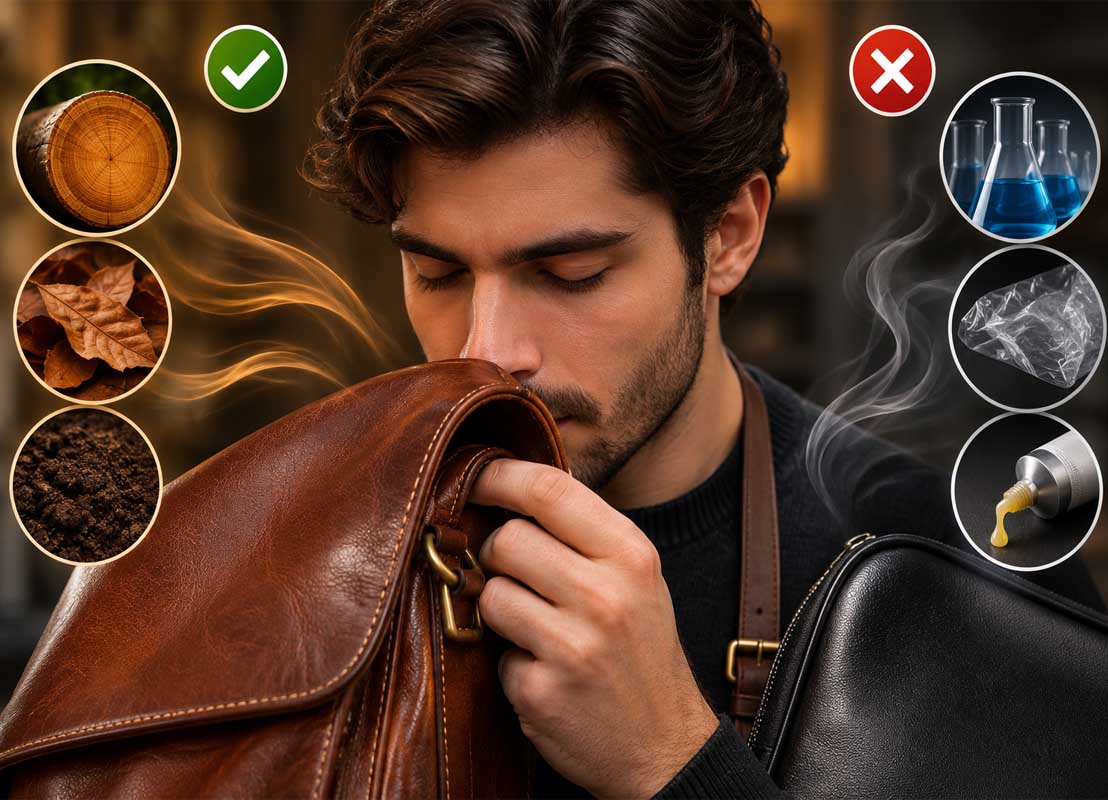
Bring the item close and smell it. Real leather has an earthy, slightly sweet scent that comes from the hide and the tanning process, and many people describe it as warm and woody. Fake leather smells of chemicals, plastic, or glue, sometimes compared with a shower curtain or a new car dashboard.
Be careful, because some sellers spray synthetic products with a leather fragrance, and heavily treated real leather can lose its natural smell. An unnaturally strong or sweet smell is a warning, not a confirmation.
Test 5: What Does the Edge Look Like?
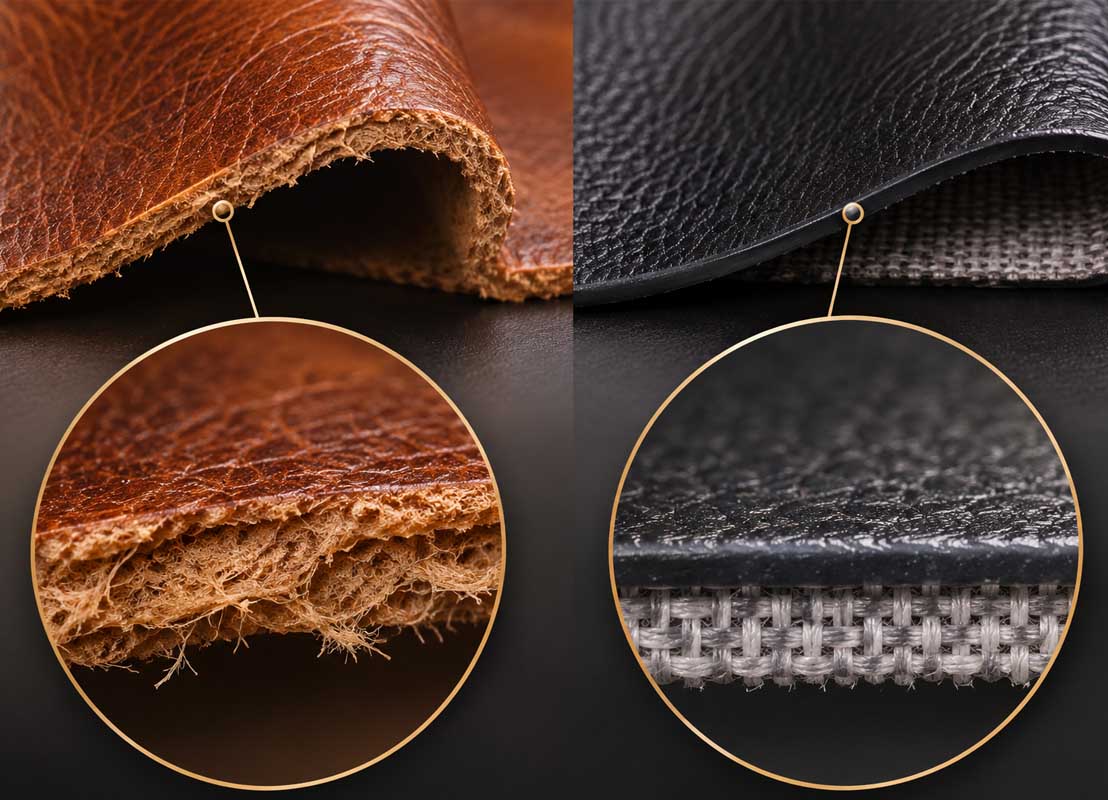
The edge is the most reliable place to look, because manufacturers cannot hide what the material is made of. Look at a cut edge, such as the edge of a strap, the underside of a flap, or the inside of a pocket. Real leather has a rough, fibrous edge with layers of tiny fibers pressed together, and it often looks slightly fuzzy, even when it is painted or burnished.
Fake leather shows a different cross-section: a clean, uniform edge with a fabric backing, such as polyester or cotton, under a thin plastic layer. A woven texture on the underside means the material is synthetic.
This test only works where an edge or underside is exposed, so use it on straps, seams, and linings. If you want to measure what you see, our guide on how leather thickness is measured explains how to check an exposed edge.
Test 6: Does a Drop of Water Soak In?
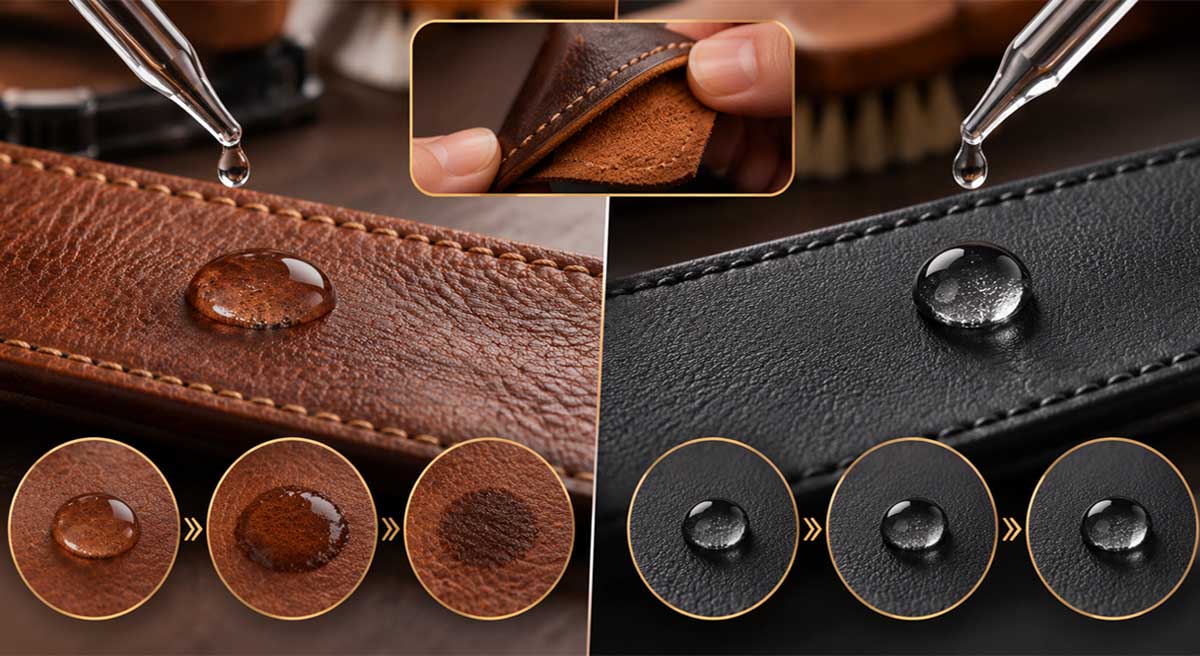
Place a drop of water on a hidden spot, such as the underside of a strap. Unfinished real leather absorbs it slowly and darkens where it sat, because the hide is porous. Many synthetics do the opposite, and the drop beads on the surface.
The catch is that finished, waxed, or sealed leather can resist water too, so a bead alone does not prove the item is fake. Treat a darkened spot as a good sign, and a bead as a reason to run another test. Dab the drop dry afterward, because water can stain some finishes.
Test 7: What Do the Label and Price Say?
Read the label and the product description closely. Terms such as full-grain, top-grain, and 100 percent leather point to real material, and a claim of full-grain or top-grain is a mark of real quality. Words such as bonded leather, leather match, man-made materials, PU, or vegan leather mean the item is not solid leather, even when the word “leather” appears.
Price is a clue, but not a proof. Real leather costs money to source, tan, cut, and stitch, so a very low price on a large leather bag should make you ask questions. A high price does not guarantee quality either, since some brands charge a premium for low-grade leather. Compare similar products, and look for the grade, the thickness, and the warranty.
Test 8: How Does It Handle a Light Scratch?
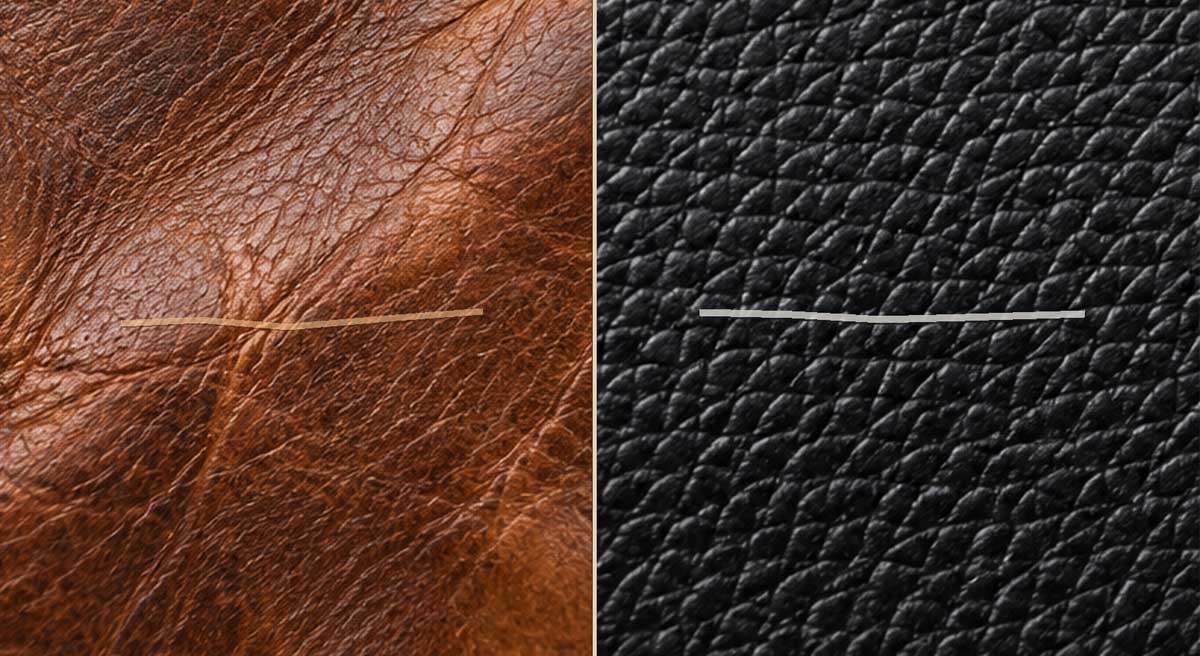
Gently drag a fingernail across a hidden area. Real finished leather shows a lighter mark that often rubs away when you massage it, because the oils in the leather move and fill the scratch.
Fake leather reacts differently. A coated synthetic often leaves a sharp scratch that does not fade, and the plastic layer may lift to show the fabric underneath. Keep this test very light and hidden.
Which Tests Should You Skip?
You will find advice online that tells you to hold a flame to the material. This is the burn test, and the common claim is that real leather chars and smells like burnt hair, while fake leather melts and smells like burning plastic. It can be informative, but it is unsafe on a finished product, because it damages the item and releases fumes, and it creates a fire risk. If you must try it, use only a loose scrap, in a ventilated outdoor space, and never on a bag you plan to keep or buy.
A good test should leave the item undamaged, so if a test needs a blade or a flame, rely on the safer checks instead.
How Do Real Leather, Bonded, Faux, and Bi-Cast Compare?
Full-grain and top-grain are the best real leathers, with strong fibers and a long life. Genuine leather is real but lower in grade, and it often wears faster. Bi-cast leather is a real split of leather topped with a polyurethane layer, and it feels more like plastic than natural leather. Bonded leather is shredded scraps and glue, and it tends to peel within a few years. Faux or PU leather has no natural leather at all and usually cracks and peels with use.
If you are buying a bag you want to keep, aim for full-grain or top-grain. A backpack such as the Adrano brown leather laptop backpack or the Javier leather travel laptop backpack shows how heavier leather and solid stitching work together in daily use.
What Red Flags Should You Watch For on a Label or Listing?
Some warning signs show up before you ever touch the bag.
- Vague wording: “leather look,” “leatherette,” or “genuine leather” with no grade.
- No material details: a listing that never says what the lining or body is made of.
- Too-good prices: a large, lined leather bag sold for a fraction of normal cost.
- Uniform photos: a surface that looks perfectly identical in every spot.
- No edge photos: no image of a strap edge or an interior seam.
- No warranty: a seller unwilling to back the product.
What Mistakes Should You Avoid When Testing Leather?
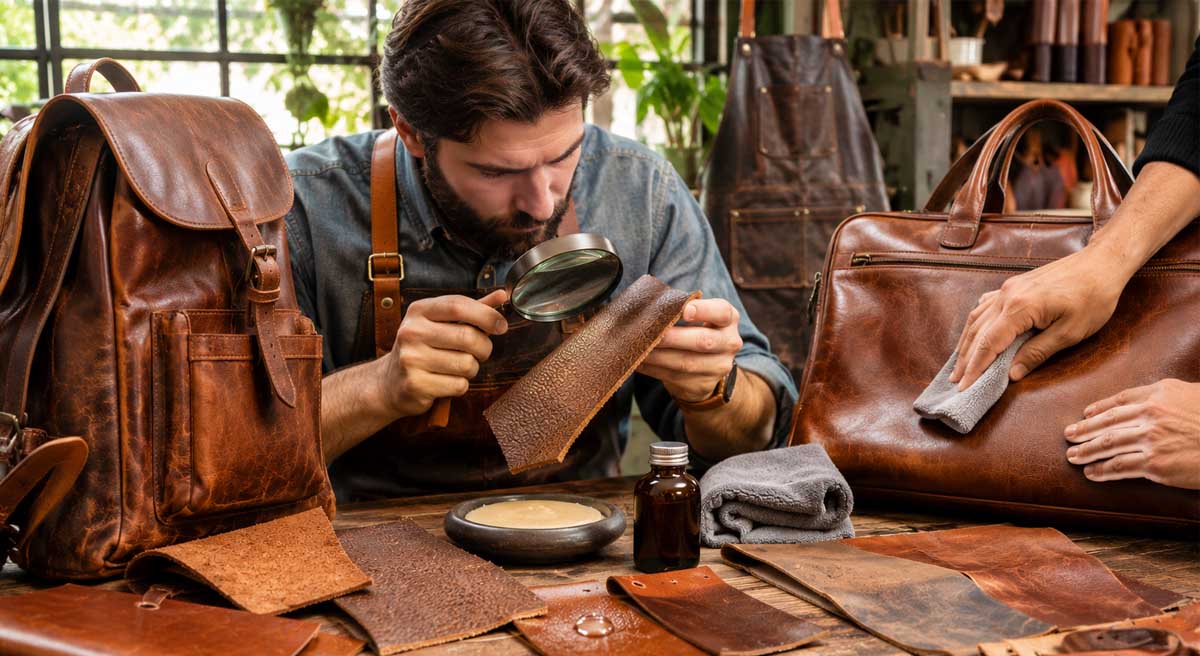
A few habits lead people to the wrong answer.
- Relying on one test: every single test has exceptions.
- Trusting the smell alone: sprays can imitate leather scent.
- Using water on a finished item: it can stain delicate leather.
- Treating “genuine” as top quality: it is a lower grade.
- Burning a finished item: it is unsafe and ruins the product.
- Judging only by price: cheap and expensive items can both disappoint.
How Do You Care for Real Leather After You Confirm It?
Once you know your bag is real, wipe it with a soft, slightly damp cloth, let it dry naturally away from heat, and apply a thin layer of leather conditioner every few months. Our guide on how to clean a leather tool belt shows a method that works well on thick, hard-working leather, and you can find more tips in our leather bag guides.
Why Buy Real Leather From Unique Leather Bags?
Unique Leather Bags (ULB) makes leather goods for people who want material they can trust. Our leather backpacks, leather laptop backpacks, and leather aprons are built with quality leather, reinforced stitching, and sturdy hardware, so they hold up to everyday use.
You also buy with confidence. ULB backs its products with a 5-year repair and exchange warranty, a 30-day return policy, and free shipping on orders over $150. The range covers men’s and women’s styles in classic browns, black, and richer colors.
Frequently Asked Questions
Check the grain for natural irregularity, look at the edge for rough fibers, smell for an earthy scent, press the surface to see if it wrinkles like skin, and test a hidden spot with a drop of water. Combine several tests, because none is perfect alone.
Yes, but it is a low grade of real leather, made from the lower layers of the hide. Full-grain and top-grain leather are higher grades and last longer.
Unfinished or lightly finished leather absorbs a drop of water and darkens briefly. Finished or waxed leather can resist water, so a bead alone does not prove the item is fake.
Fake leather often smells of plastic, glue, or chemicals. Some sellers add a leather scent, so use smell together with other tests.
No. Burning releases fumes and creates a fire risk, and it damages the product. If you try it, use only a loose scrap in a ventilated outdoor area.
No. Price is a clue, not proof, because some products charge a premium for low-grade leather. Check the grade, the edge, and the label as well.
Final Thoughts
Spotting real leather takes a few minutes and a little patience. Start with the grain and the edge, add the smell and press tests, and finish with the label and a careful water drop. Remember that “genuine leather” is a grade, not a guarantee, and that no single test settles the question alone. Three or four consistent signs give you a confident answer.
When you are ready to buy, browse our leather backpacks or look at the Ragnar dark brown full grain leather apron and the Blacksmith full grain leather apron to see real, full-grain leather in use.


