


Carry a backpack if your commute is long, your load is heavy, or you walk, cycle, or take transit. Carry a briefcase if you travel light, work in a formal office, or meet clients often. A backpack spreads weight across both shoulders and holds more, while a briefcase looks sharper and keeps documents flat. If you need both, a leather briefcase backpack gives you a middle path.
Key Takeaways
- A backpack suits long commutes and heavy loads, because both shoulders share the weight.
- A briefcase suits short trips, light loads, and formal workplaces.
- Dress code matters, but a leather backpack now passes in most offices.
- Quality leather in either style lasts for years and often costs less per year than cheap bags.
- Check your laptop size first, because it decides which bag will actually fit.
- A hybrid briefcase backpack is the safest pick if your week includes both situations.
Why Is This Still a Hard Choice?
Ten years ago the answer was simple: backpacks were for students, and briefcases were for professionals. That line has blurred. Many offices now allow relaxed dress, laptops have replaced stacks of paper, and a well-made leather backpack looks as polished as a satchel. At the same time, briefcases have not disappeared, because they still carry a certain authority in a meeting room that no zip-top rucksack quite matches.
So the real question is not which bag is better. It is which bag fits the way you actually move through your day. A person who walks twenty minutes to a train and stands for most of the ride has different needs from someone who drives to a parking garage and walks straight to an elevator. This guide skips the generic pros and cons and starts from five common work lives, then gives you a quick test to confirm the choice.
Which Bag Suits Your Work Life?
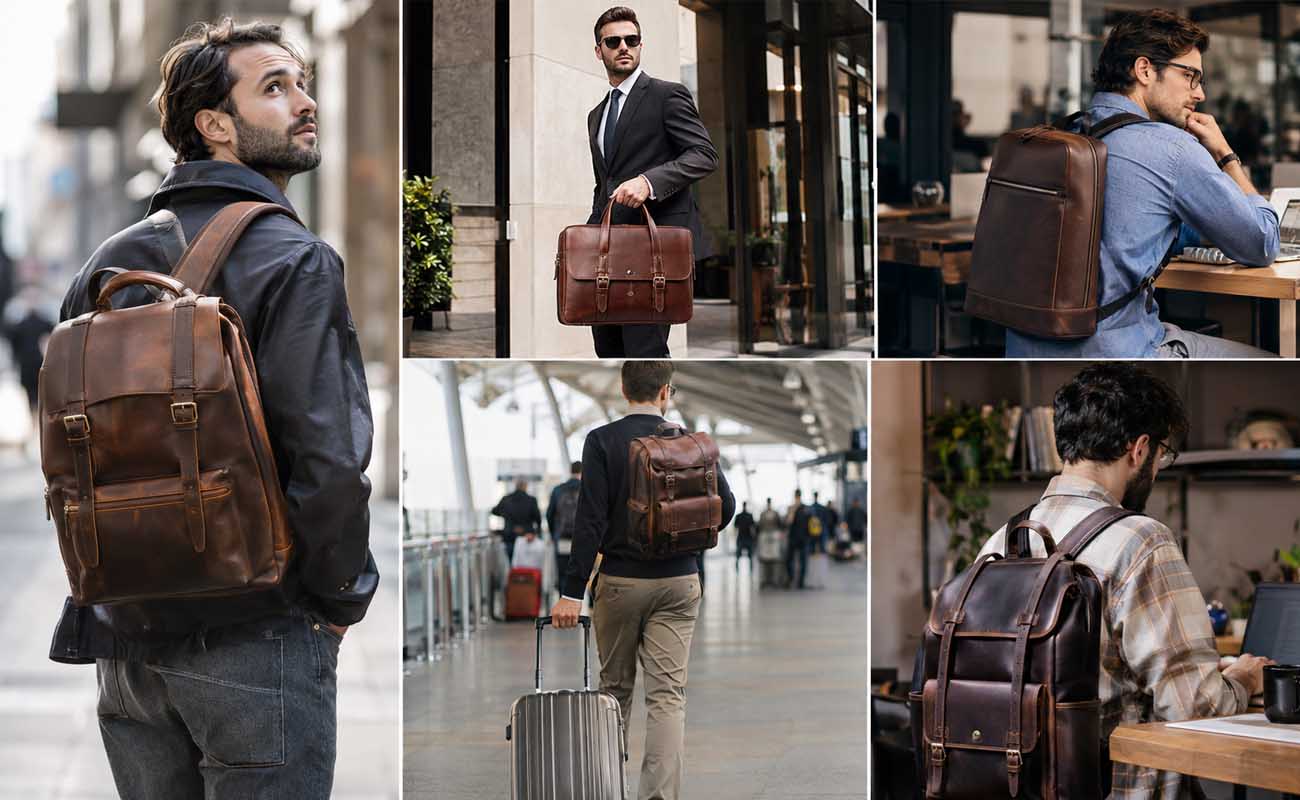
Find the profile closest to yours. Each one gives the likely winner and the reason, so you can see the logic and not only the verdict.
- The Long-Distance Commuter (30+ minutes on foot, bike, or transit):
- Pick: a backpack.
- Why: a briefcase hangs from one hand or shoulder, and that uneven load gets tiring over a long trip. A backpack spreads the weight across both shoulders and keeps your hands free for a rail, a phone, or a coffee.
- Look for: padded straps and a padded back panel.
- The Client-Facing Professional (meetings, presentations, handshakes):
- Pick: a briefcase.
- Why: it signals that you take the occasion seriously, keeps documents flat, and sits neatly beside your chair or on a conference table.
- Look for: a structured leather shape that ages into something that looks more established each year.
- The Hybrid Worker (home office, shared desk, occasional client visit):
- Pick: a slim leather backpack for most days, and a briefcase for formal ones.
- Why: your week needs flexibility.
- Look for: a briefcase that converts to a backpack, if you would rather own one bag.
- The Frequent Traveler (airports and train stations):
- Pick: a backpack.
- Why: it is easier to carry through crowds, up stairs, and across long terminals, and it frees your hands for a passport and boarding pass.
- Look for: a dedicated laptop compartment and a quick-access pocket. Check your airline’s size rules for carry-on and personal items, because limits differ by carrier.
- The Creative or Tech Worker (relaxed office, laptop and gear):
- Pick: a backpack.
- Why: a leather one looks sharp without a suit, and the extra compartments keep your laptop, charger, and notebook organized.
- Look for: a briefcase only if you travel light, since it is often more bag than the setting needs.
How Do You Decide in Three Questions?
If none of the profiles fits, use this quick test. First, how long is your longest carry? If it is over 20 minutes on foot or on transit, lean toward a backpack. Second, how heavy is your typical load? If you regularly carry a laptop, a charger, a lunch, and a few books or files, a backpack handles it better. Third, how formal is your most important meeting? If it is a client or an interview in a suit, a briefcase makes the stronger first impression.
Two or three answers pointing the same way settle it. If the answers split, the hybrid is your bag, or you can own both and choose by the day.
Which Is Better for Your Back and Shoulders?
A backpack is generally easier on the body for heavy loads, because the weight rides on both shoulders and close to your center of gravity. A briefcase puts the entire load on one arm or one shoulder, which can lead you to tilt or hunch to compensate. For a light load, the difference is small. For a heavy one, it adds up over weeks.
A common guideline, often cited for students and used widely for everyday carry, is to keep a bag under roughly 10 to 15 percent of your body weight. If you do carry a briefcase, switch hands regularly. If you wear a backpack, use both straps, adjust them so the bag sits high on your back, and use the chest or waist strap if it has one. Ask a doctor or physiotherapist if you have ongoing back pain, because bag choice is only one factor.
How Do They Compare on Space and Organization?
A backpack usually offers more volume and more compartments, such as a padded laptop sleeve, a main section, and front pockets. That makes it ideal for people who carry more than a laptop and a folder. The trade-off is that a stuffed backpack can feel like a jumble, and things at the bottom are harder to reach.
A briefcase has less room, but its space is organized for work. Documents lie flat, a tablet or laptop sits in a protected sleeve, and pens and cards have small pockets of their own. It is a better fit for a person who carries a few items and wants them easy to find. If your load is mostly a laptop and a notebook, you may not miss the extra room.
Which One Looks More Professional?
Briefcases carry the traditional authority. They suit law, finance, consulting, and any meeting where you want to look formal. A leather briefcase in brown or black reads as polished and deliberate.
Backpacks have caught up. A structured leather backpack with clean lines, minimal hardware, and a muted color can pass in many offices, particularly in creative, tech, and hybrid workplaces. The difference is the material and the shape. A nylon bag with large logos looks like a gym bag in a meeting. A slim leather bag looks like part of your outfit. When in doubt, check what your colleagues carry and go one notch smarter.
How Do They Compare at a Glance?
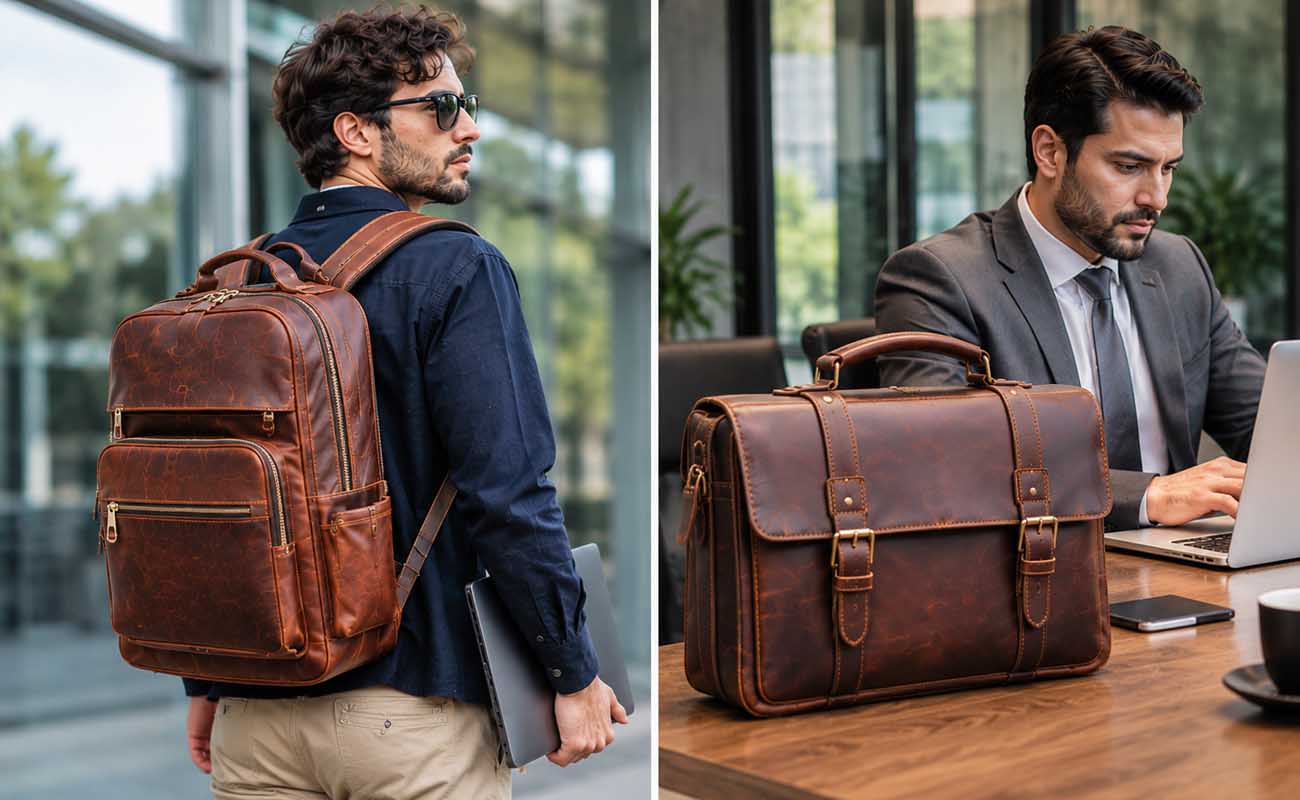
This table sums up the main differences.
| Factor | Backpack | Briefcase |
| Weight distribution | Both shoulders | One arm or shoulder |
| Capacity | Higher | Lower |
| Formal look | Good if leather and slim | Strongest |
| Hands free | Yes | No (unless a strap is used) |
| Best for | Long commutes, travel | Short trips, meetings |
| Laptop protection | Padded sleeve | Padded or structured |
Does Leather Change the Decision?
Yes, in two ways. First, leather raises the formality of a backpack, which is why a leather one can work in settings where a nylon one cannot. Second, leather lasts. A well-made leather bag can serve for many years and develops a patina as it ages, which is part of its charm. Look for full-grain or top-grain leather, because the word “genuine” alone is a lower grade. Our guide on bi-cast leather vs genuine leather explains the difference and how to avoid a coated imitation.
Leather is heavier than nylon, so check the weight of the empty bag, especially if you carry a laptop and walk a lot. A good leather backpack balances that weight with sturdy straps and a padded back, while a briefcase is a better match when you carry little. If you want to see how leather fits the rest of the bag family, our article on sling bags vs messenger bags shows the alternatives to both.
What About a Hybrid or a Third Option?
If you cannot decide, consider a bag that borrows from both. The leather briefcase backpack pairs a structured, professional look with backpack straps, so you can carry it by hand into a meeting and on your back for the commute. It is a good fit for hybrid workers and frequent travelers.
Another option is the messenger or satchel style, which sits between the two in formality and carry. It hangs across the body, keeps your hands free, and still looks smart. Our comparison of satchel vs messenger bags explains how they differ. You can browse our leather messenger bags if that style appeals.
How Should You Pack Each Bag?
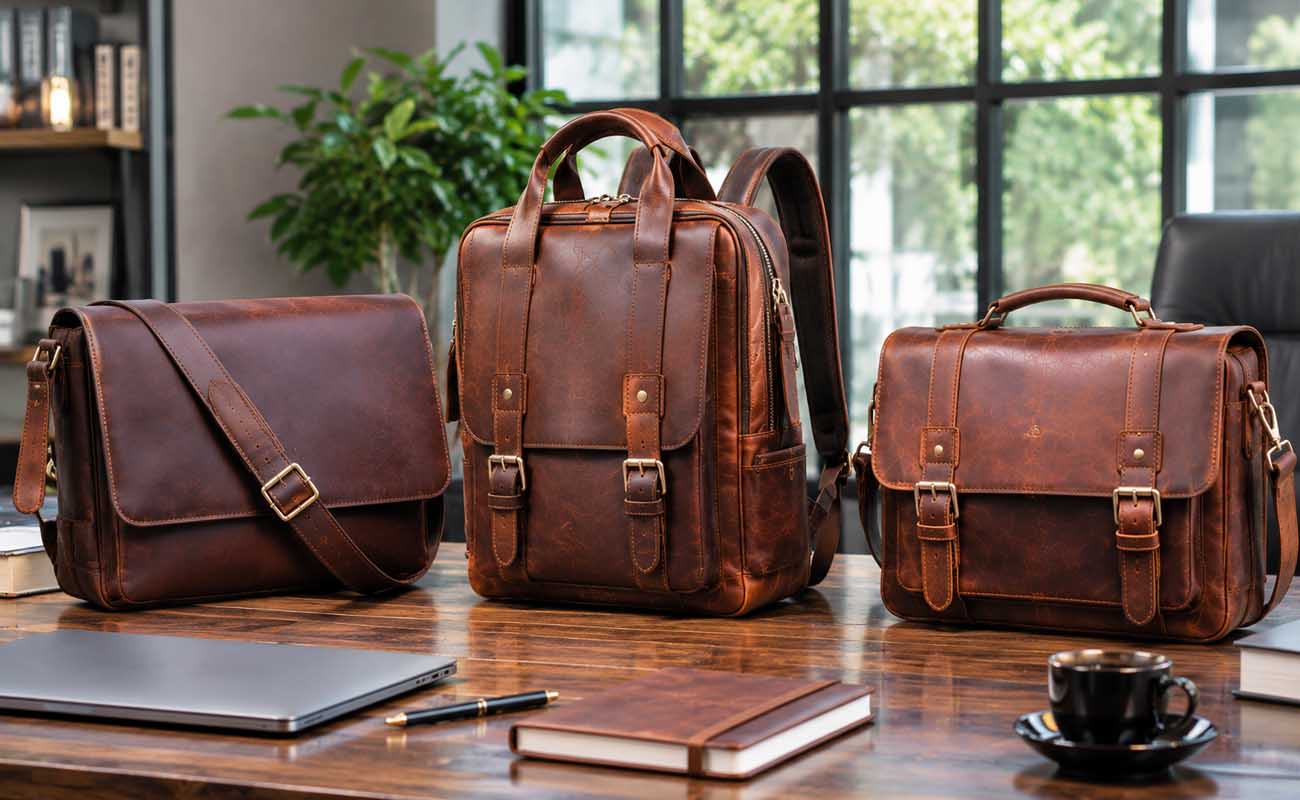
A few habits keep either bag comfortable and neat.
- Heavy items close to your back: in a backpack, put the laptop and heavy items against the back panel.
- Lighter items on top: keep a lunch, a jacket, or a scarf near the top.
- Use the sleeve: keep the laptop in its padded compartment, not loose.
- Keep the briefcase flat: stack documents and a tablet so the bag holds its shape.
- Carry only what you need: remove old papers and extra cables every week.
- Use a pouch for small items: cables, pens, and cards stay easy to find.
What Mistakes Should You Avoid?
A few common errors lead to a bag you stop using.
- Buying for the best day only: choose for your most common day, not your rarest one.
- Ignoring laptop size: check the sleeve against your actual laptop, with a little room.
- Choosing a briefcase for a heavy load: one-sided weight becomes tiring quickly.
- Choosing a casual backpack for formal settings: shape and material matter.
- Overstuffing: a bulging bag looks sloppy and strains the straps and seams.
- Buying by price alone: a cheap bag that fails costs more than a good one.
How Much Should You Spend?
Backpacks usually cost less at the entry level, while quality briefcases cost more, because they rely on structure, hardware, and finish. That is a general pattern, not a rule, and prices vary widely by material. What matters more is cost per year. A bag you carry five days a week for eight years costs a few cents a day, even at a higher price, while a cheaper bag that cracks in two years costs more in the end.
Spend more on the parts that wear: the straps, the handles, the zippers, and the stitching. Check the leather grade, the hardware, and the warranty. If you can afford only one good bag, buy the one you will use most often, and add the second later.
Which Leather Bags Should You Look At?
If you chose a backpack, start with our leather laptop backpacks and men’s leather backpacks. The Adrano brown leather laptop backpack and the Duluth leather laptop backpack are built for work and travel.
If you chose a briefcase, look at the full-grain classic leather briefcase or the leather briefcase laptop bag. For a broader view, see all of our leather backpacks.
Why Buy a Work Bag From Unique Leather Bags?
Unique Leather Bags (ULB) makes leather backpacks and briefcases built for daily work, with quality leather, reinforced stitching, and sturdy hardware, so they hold up to commutes and travel and look better with age. Whether you want a roomy backpack or a structured briefcase, you can choose by how you work and not by what is on a shelf.
You also buy with confidence. ULB backs its products with a 5-year repair and exchange warranty, a 30-day return policy, and free shipping on orders over $150. For more advice on choosing and caring for leather, browse our leather bag guides.
Frequently Asked Questions
A backpack is better for long commutes, heavy loads, and travel, and a briefcase is better for formal settings and light loads. Choose by your commute and your workplace.
Yes, if it is a slim, structured leather bag in a neutral color. Casual nylon bags with large logos are less suitable for formal offices.
Not by itself, but carrying a heavy load on one arm or shoulder can cause strain. Keep the load light, switch sides, and use a shoulder strap if the bag has one.
Yes, if it has a padded laptop sleeve that fits your device. Keep the laptop against the back panel and avoid overstuffing.
Yes. A briefcase backpack has a structured look and carries by hand or on your back, which suits hybrid workers and travelers.
Final Thoughts
The best bag is the one that matches your day. If you walk, ride, or travel with a heavy load, a backpack is the comfortable choice. If you work in a formal setting and carry little, a briefcase makes the stronger impression. If your week includes both, a hybrid or owning one of each solves the problem. Check your laptop size, choose quality leather, and buy for the bag you will actually carry most.
When you are ready, browse our leather laptop backpacks or the leather briefcase backpack.


